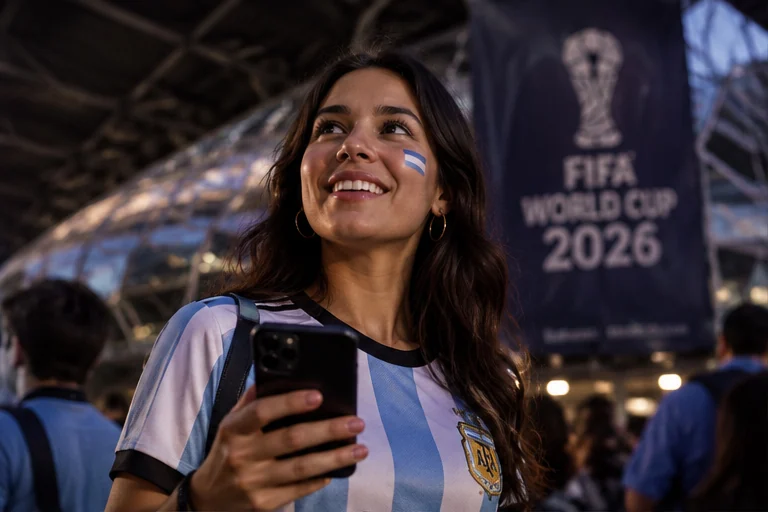
The First-Time International
- Motivations
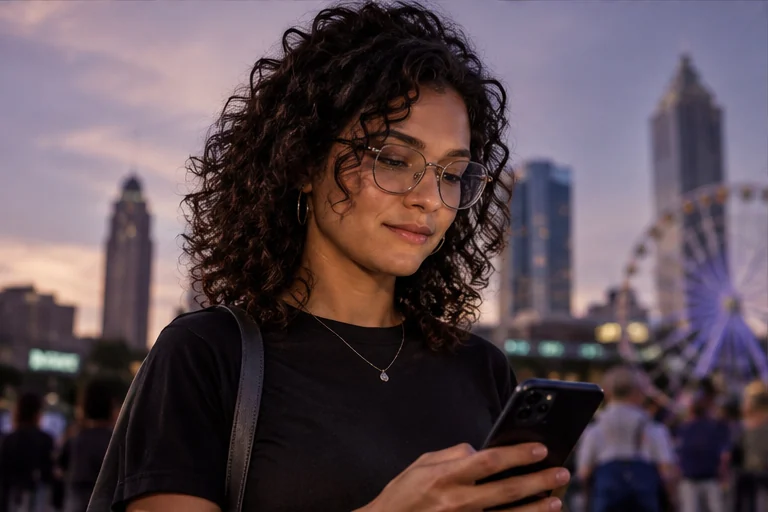
- Experience Southern hospitality, follow their team and find the best local food.
- Pain points
- Language barriers, fear of getting lost in a city that isn’t built for walking, and unpredictable MARTA schedules.
 Archana
UI/UX Designer
Where logic and instinct have to agree.
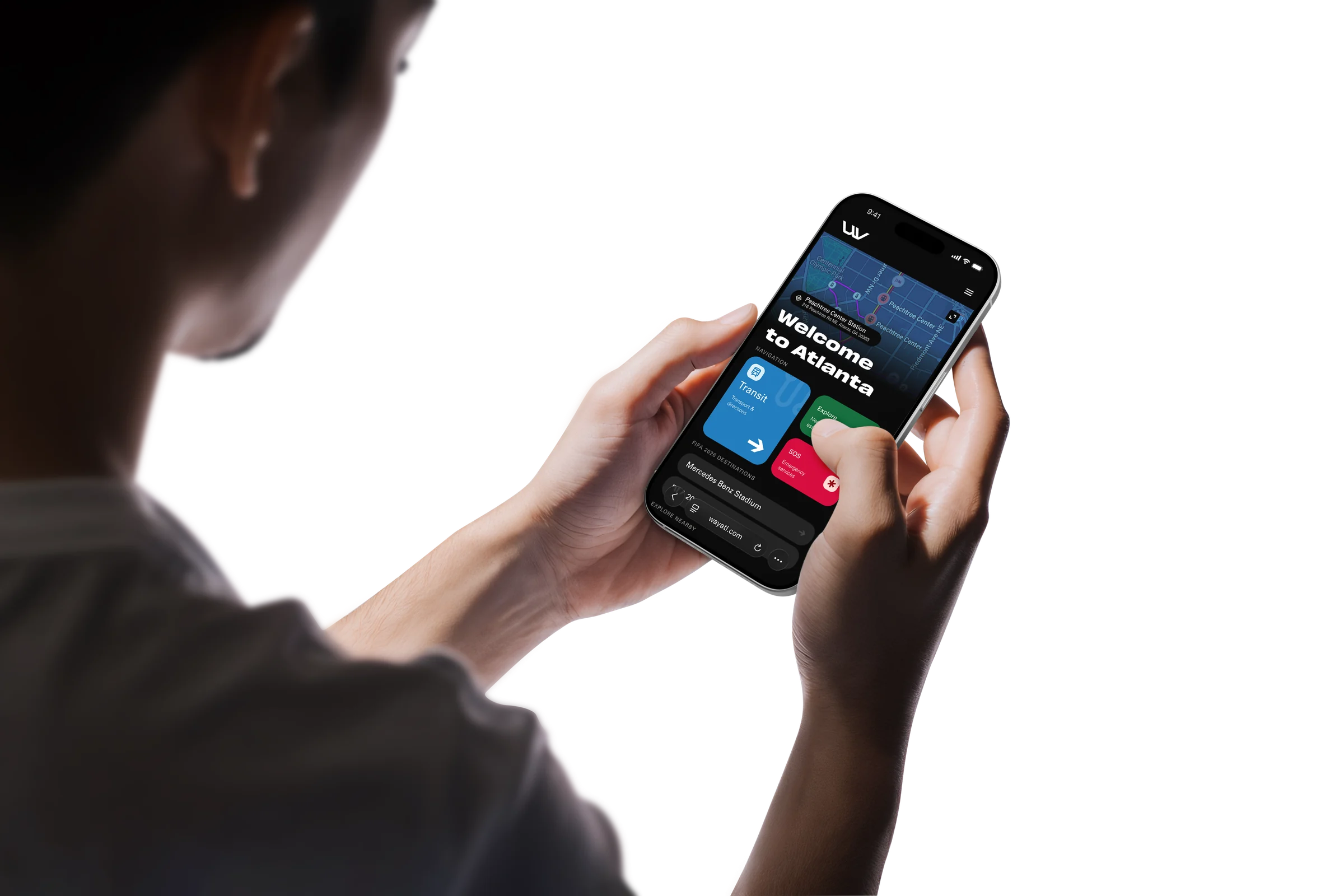
WayATL is a location-aware progressive web app built to help FIFA World Cup fans navigate the city during one of the largest events Atlanta has ever hosted. As Lead UX Designer, I led research and design for a wayfinding experience built for a multilingual, high-volume crowd operating under real safety and operational constraints.
01 — Problem
For the 2026 FIFA World Cup, hundreds of thousands of international and out-of-state fans will arrive in Atlanta, most of them finding their way through an unfamiliar city in an unfamiliar language. Without clear, accessible wayfinding, the fan experience starts to break down before match day even begins.
A partner team designed the city’s physical signage: static, in English, and useful once a fan is close enough to read it. Our challenge was the gap before that point: reaching fans sooner, wherever they start, long before they ever see a sign.
World Cup matches hosted in Atlanta
unique spectators expected at matches
of fans travelling from outside Georgia
Fans arriving in Atlanta for the World Cup are navigating a city most have never visited, often in a language other than English, with no single, reliable source for transit, nearby essentials or emergency information. Static signage and generic map apps weren’t built to close that gap at the moment a fan needs it most: standing on an unfamiliar corner, unsure where to go next.
…give a multilingual crowd of first-time visitors instant access to exactly what they need, right where they’re standing, with no app download, no login and no prior knowledge of the city?
02 — Opportunity
We didn’t start from a blank page. The solution was decided before research began.
WayATL grew out of SCADpro’s founding pitch: the proposal that brought the school and the Metro Atlanta Chamber on board was built around one specific concept. By the time our team joined, the format wasn’t something to discover. It was the premise the client had already signed on to.
Mobile web, not an app
Opens in the browser. No download, no account, no login.
Launched from the street
A QR code or NFC tap on the totems and signage already going up across the city.
Aware of where you stand
Each touchpoint knows its location and serves what a fan needs from that exact spot.
What should we build?
How do we build this well, and is it right for the people who’ll use it?
03 — Research
Fans lose their way at moments of transition: arriving at the airport, transferring on MARTA, walking to the stadium and pushing through the exit crush. Wayfinding should be concentrated where one mode of travel ends and the next begins.
Fans arrive with different cultural needs, and for some, privacy is the only reason they’ll use the system at all. Staying anonymous, with no login, is a baseline requirement, not an extra.
Every scan adds to a picture of how people move through the city. That intelligence should support Atlanta’s historically overlooked neighborhoods, not just its commercial districts.
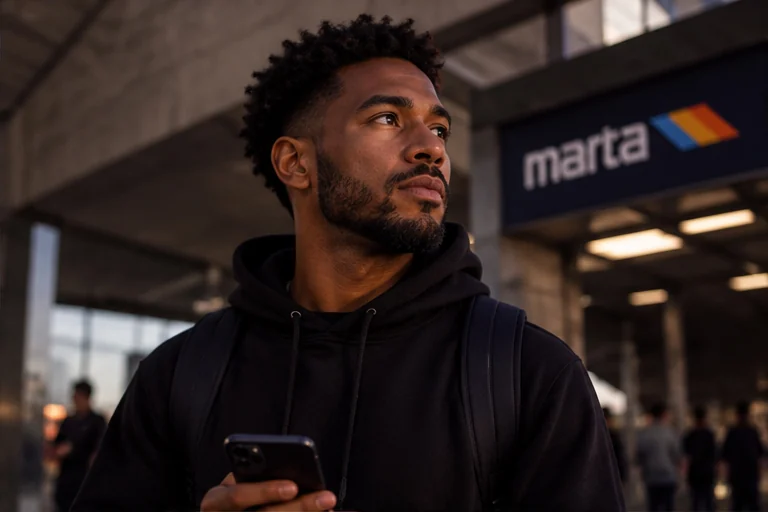
Fans don’t pass through Atlanta once. They repeat this journey across an eight-match event, and each stage asks something different of WayATL.
Lands at Hartsfield-Jackson and asks “where do I go?” before even leaving the airport.
Loops hotel → Fan Fest → food → stadium, day after day, for the length of the tournament.
In a crowd of 71,000+, needs help fast: lost, unsafe or wary of drawing attention.
The stadium hits capacity, and half-time and full-time send sharp surges into the streets.
Tired, maybe separated from their group, racing the crowd to transit or a flight.
The first scan reads the phone’s language, pins “You are here” to their hotel and hands off gate-to-gate MARTA directions.
Walking times measured from that exact totem, not a generic GPS estimate.
SOS and evacuation maps from the same tap. No login, no extra app to remember.
Live drop-off and re-entry data points to the least congested MARTA access.
The same live data, flipped to get fans out and onto transit fast.

04 — Ideation
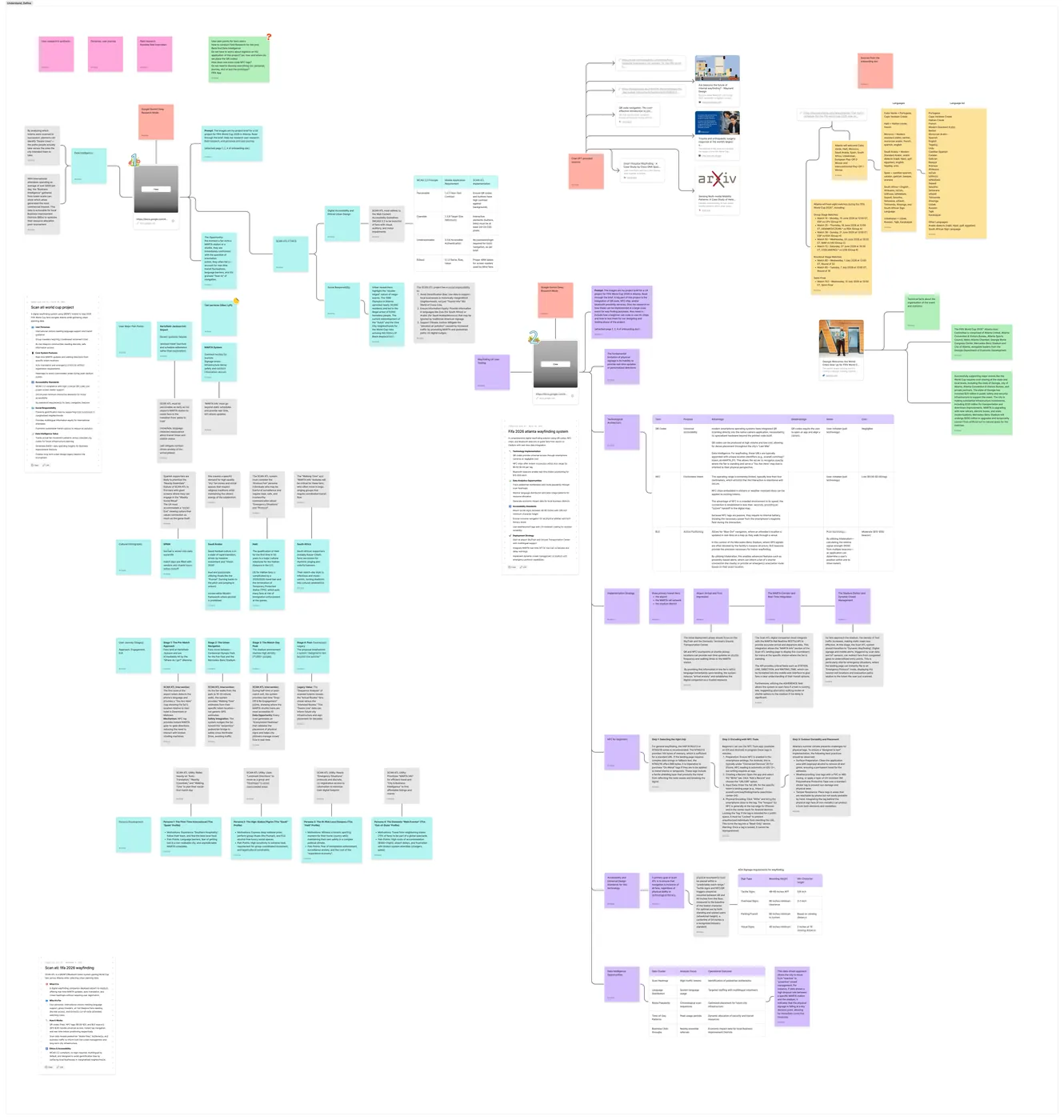
With the format already set, ideation focused on how WayATL should look, feel and behave, so we used AI-assisted development to explore that space quickly. Working across several AI generators, we produced a wide range of wireframe iterations, each testing a different take on layout, navigation and how a fan would actually move through the experience.
Generating many directions in parallel let us compare options side by side and spot what worked across versions. From there, we narrowed the strongest ideas into a single direction to carry into prototyping. AI widened the field; design judgment decided what stayed.
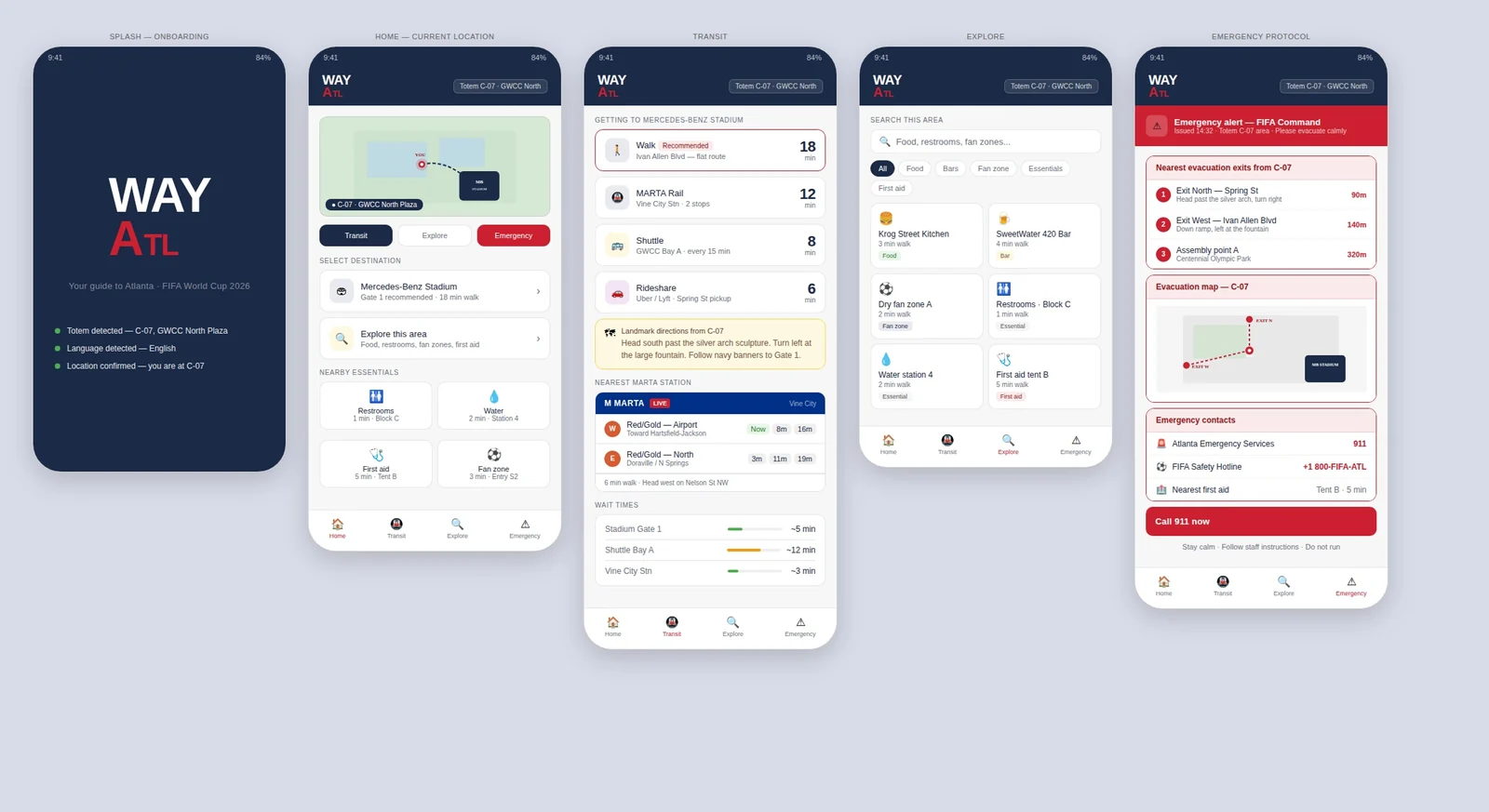
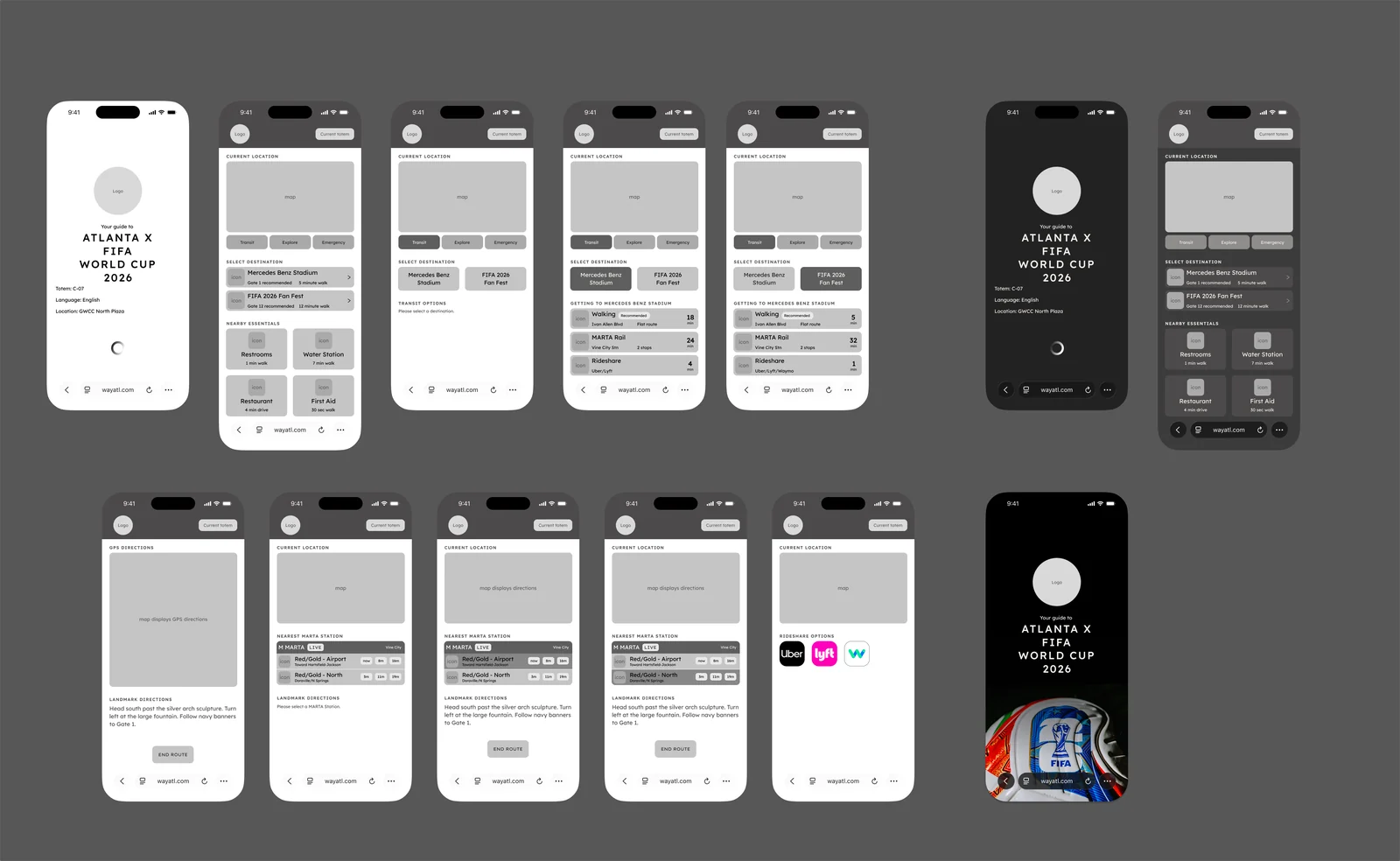
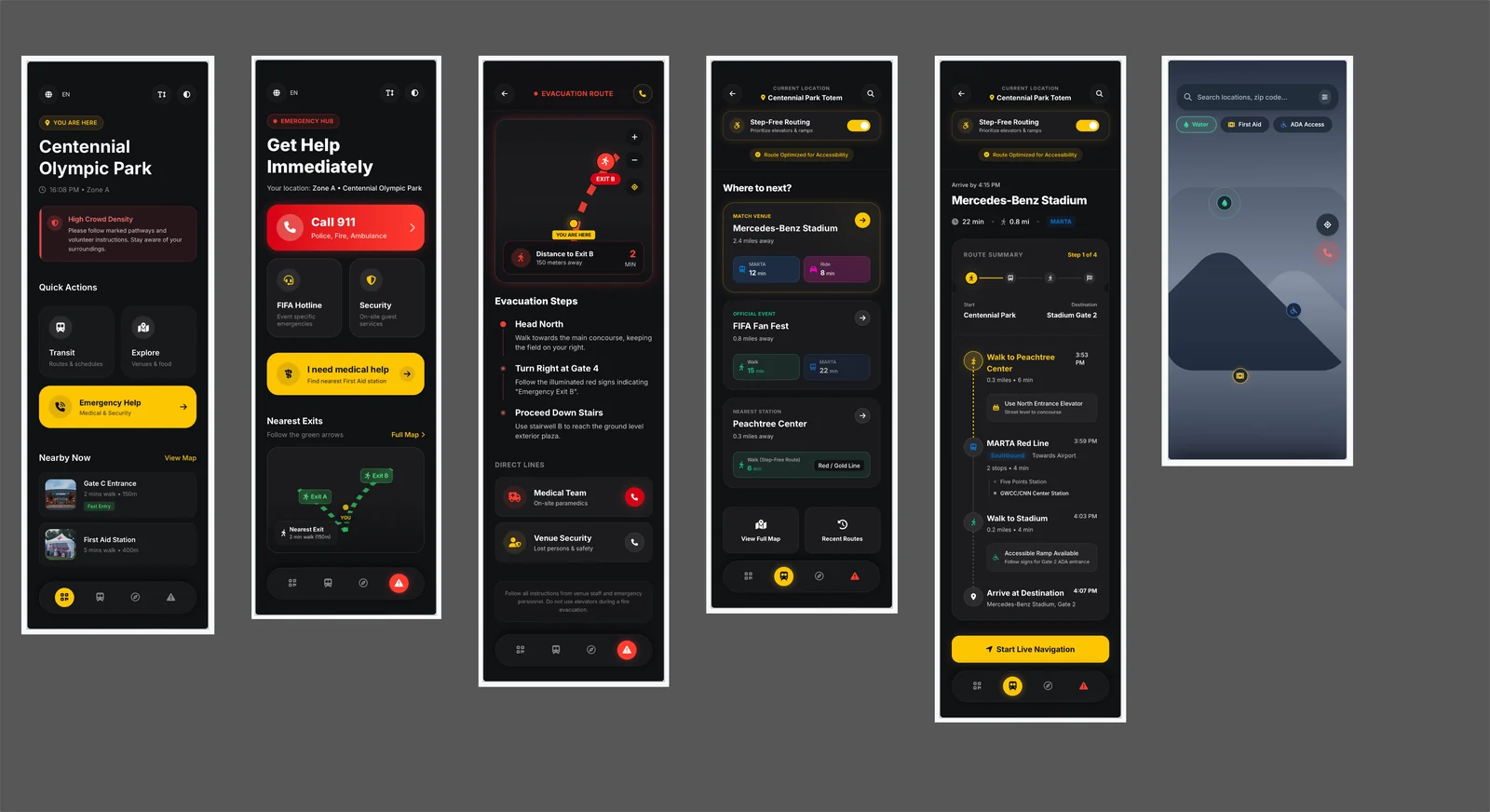
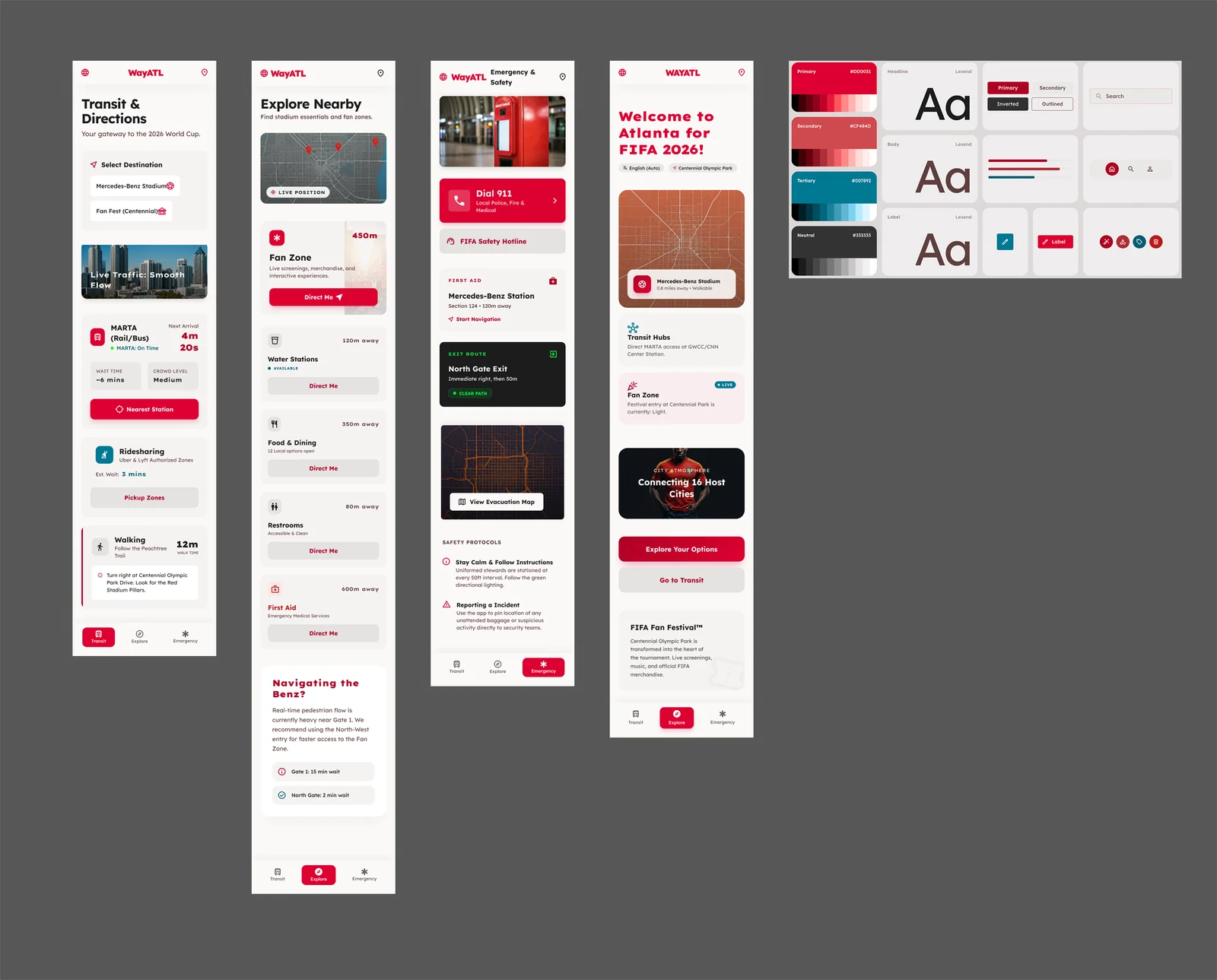
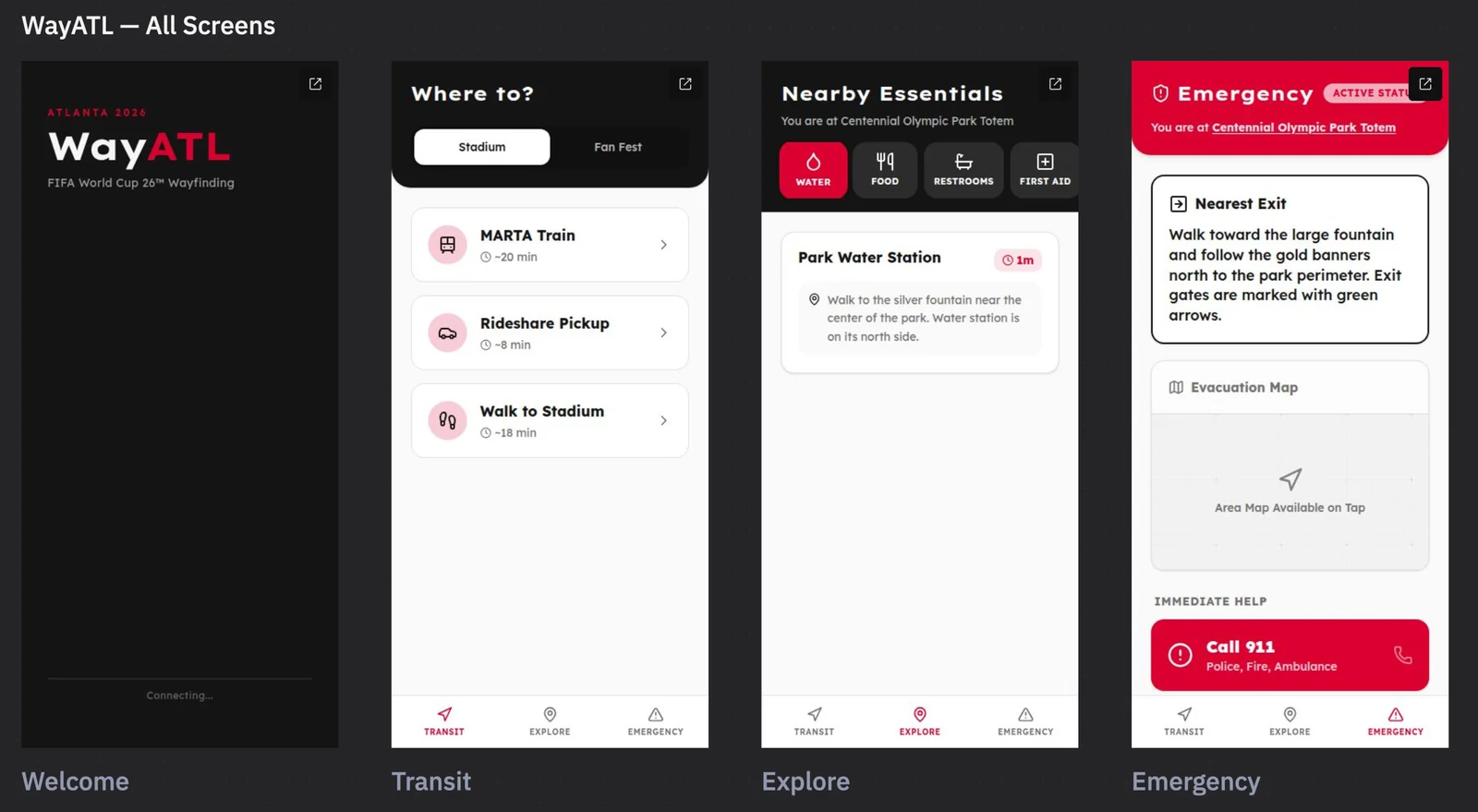
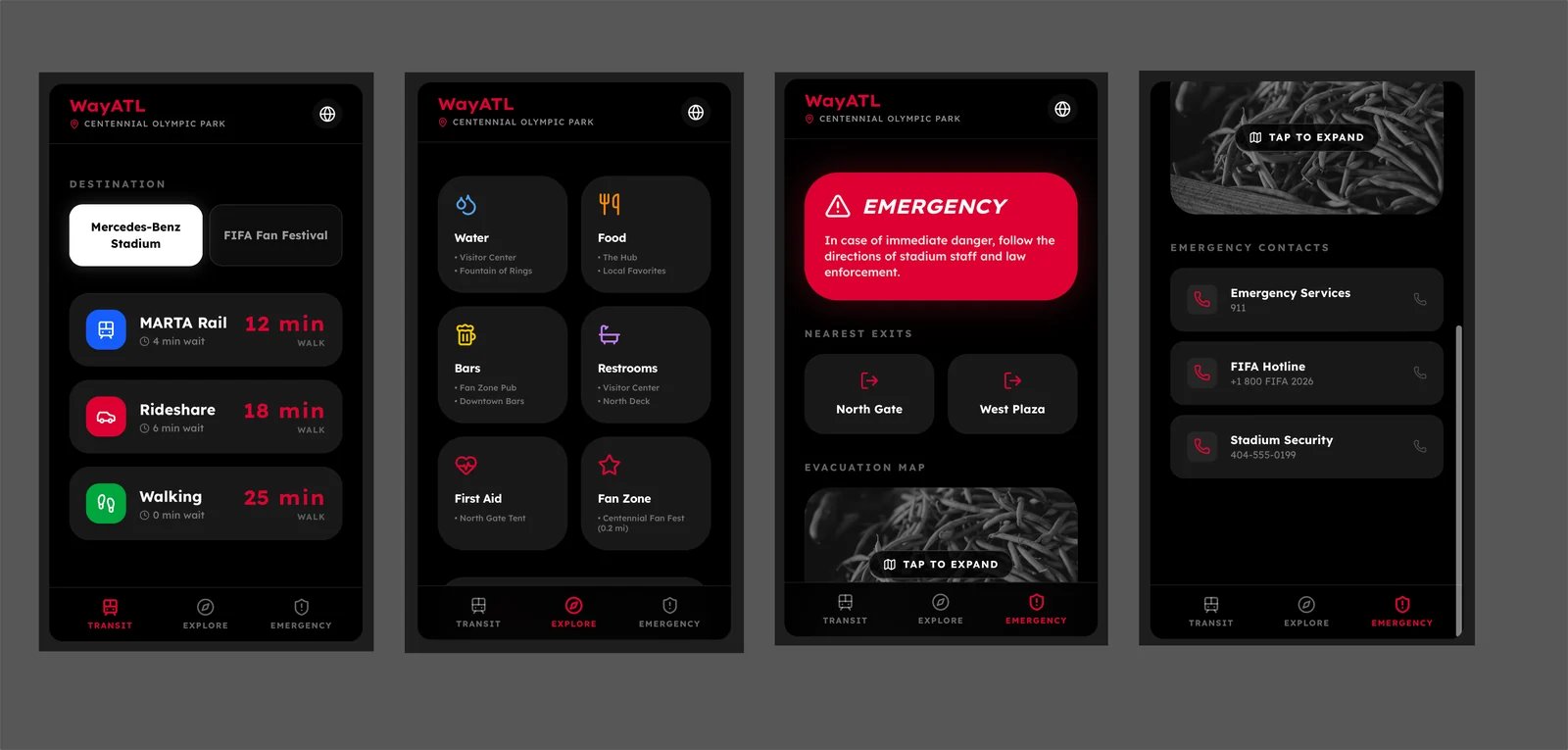
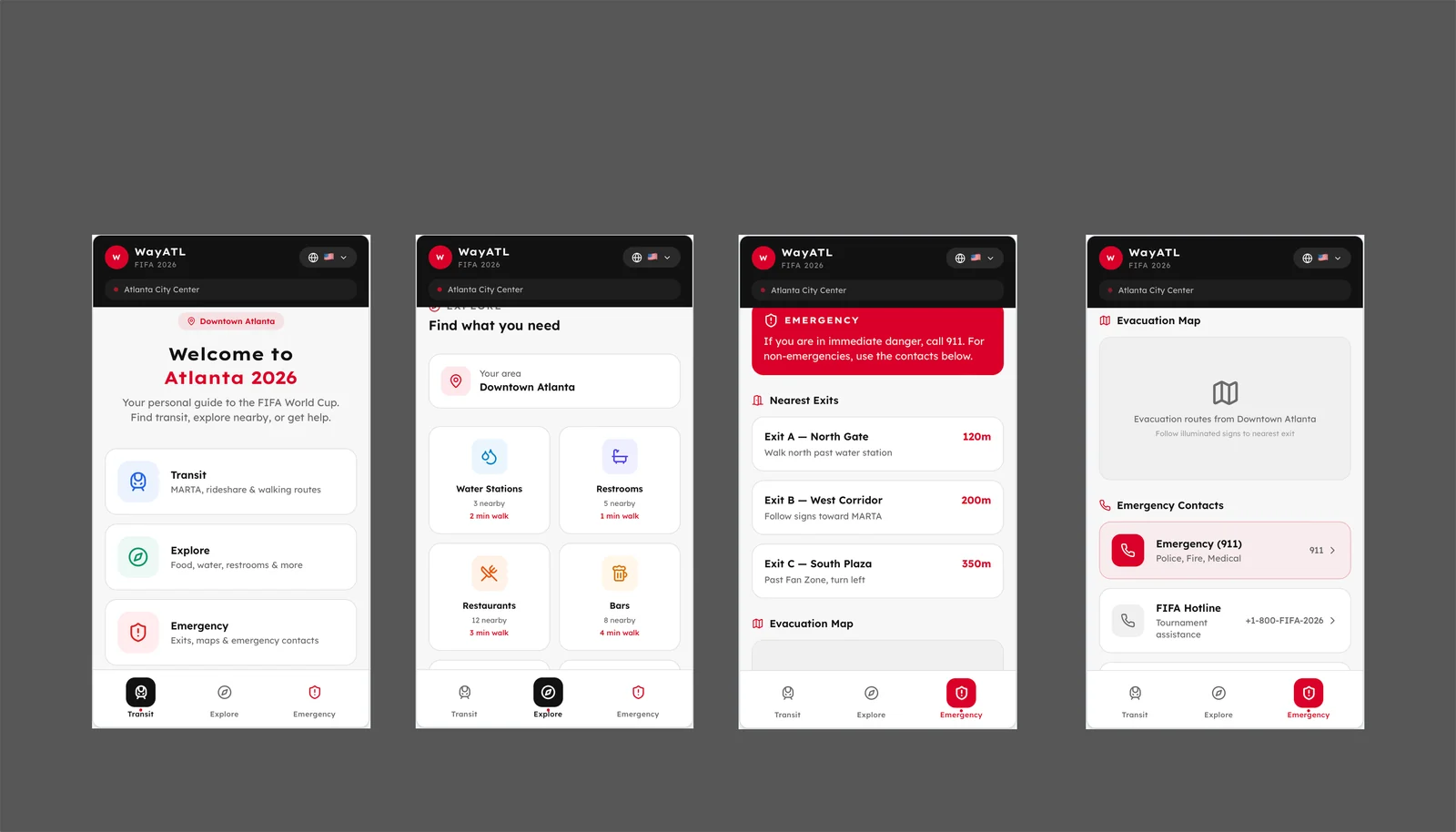
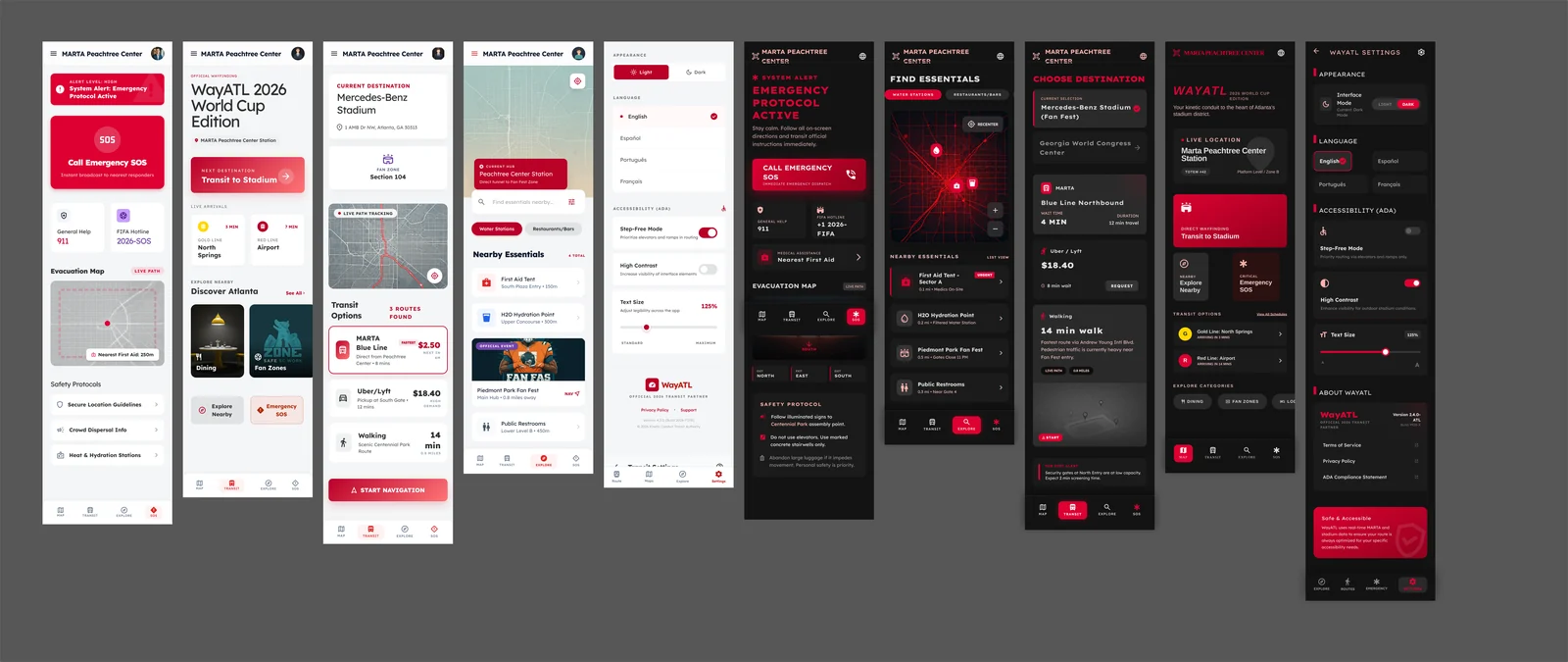
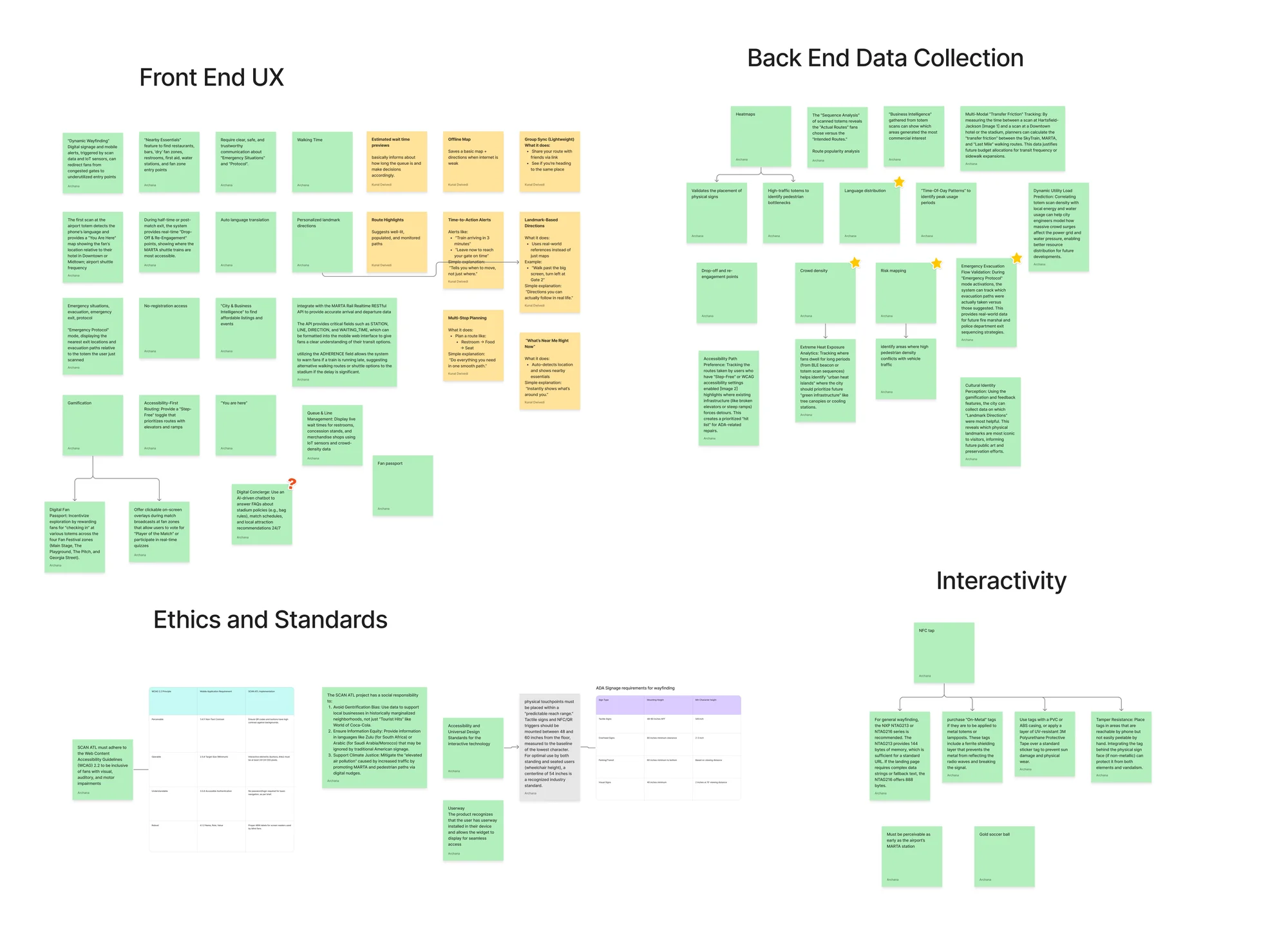
Once the iterations surfaced what fans needed most, we grouped every feature into clear themes, then turned those themes into the information architecture behind WayATL’s navigation.
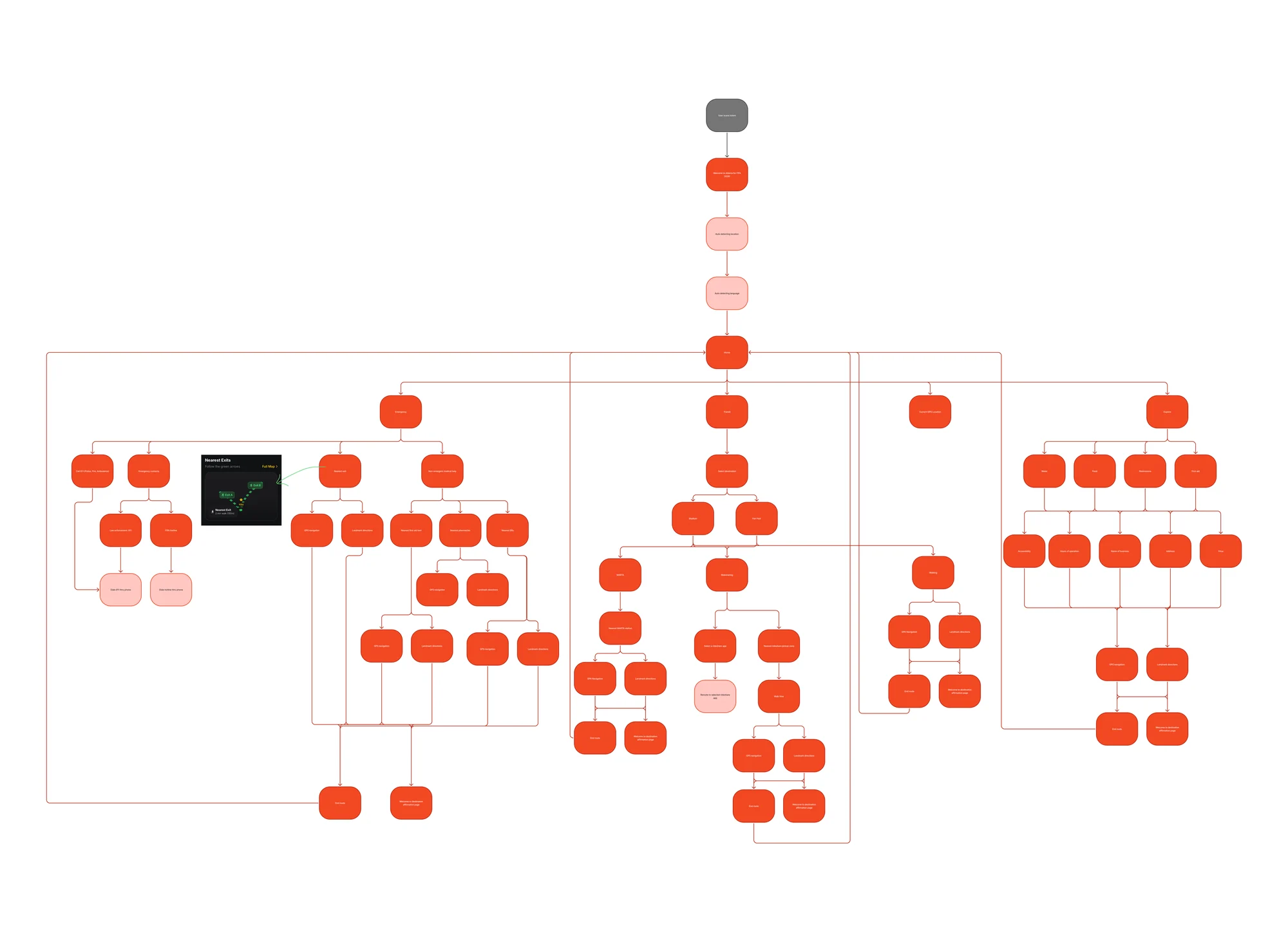
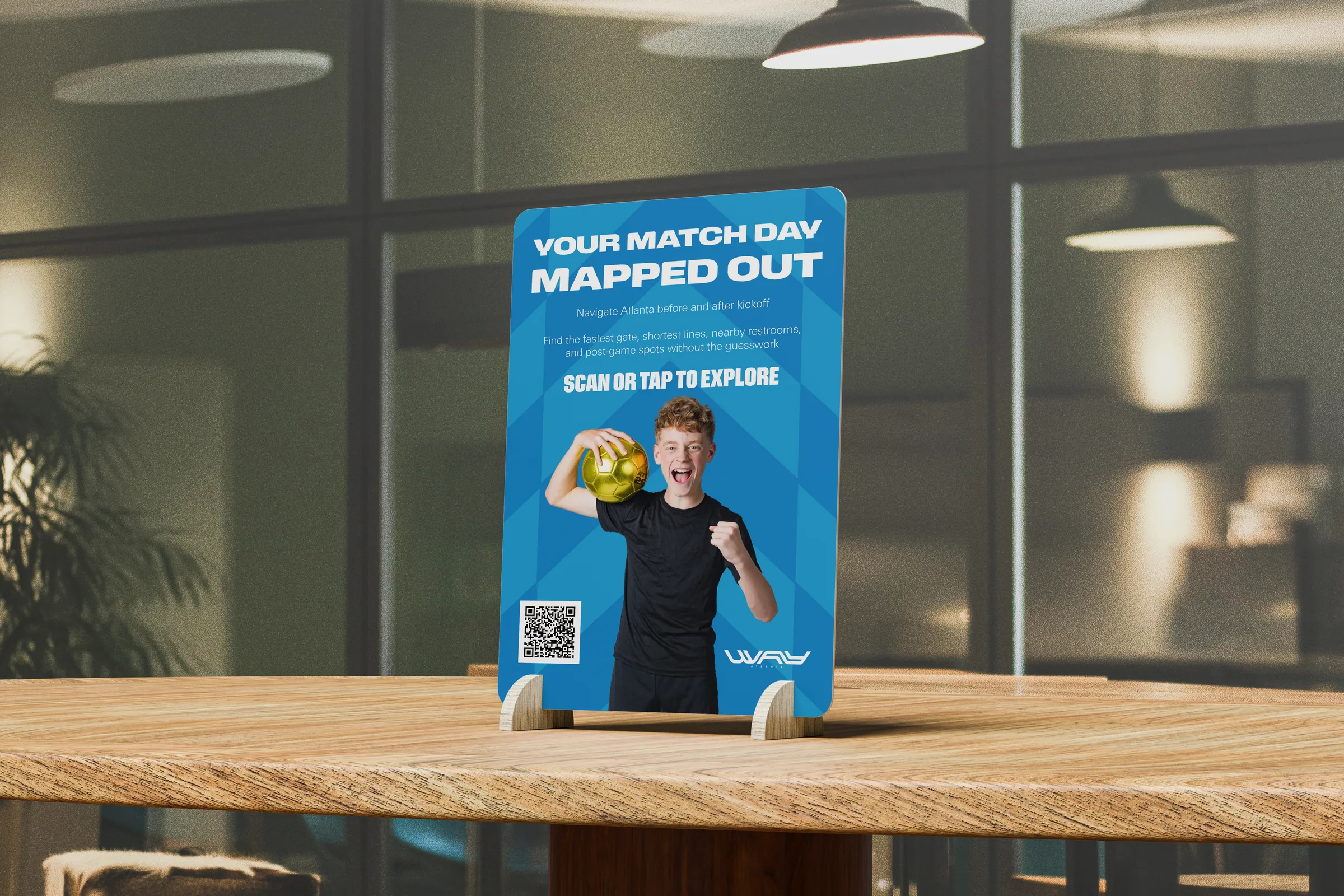
WayATL is a mobile-first web experience activated by physical towers. To reach it, a fan scans one of these towers, whether it’s FIFA’s official signage or a tabletop sign.
Every visit starts on the same home screen. From there, a fan is never more than two taps from what they came for: getting somewhere, finding something nearby, or getting help.
05 — Prototyping
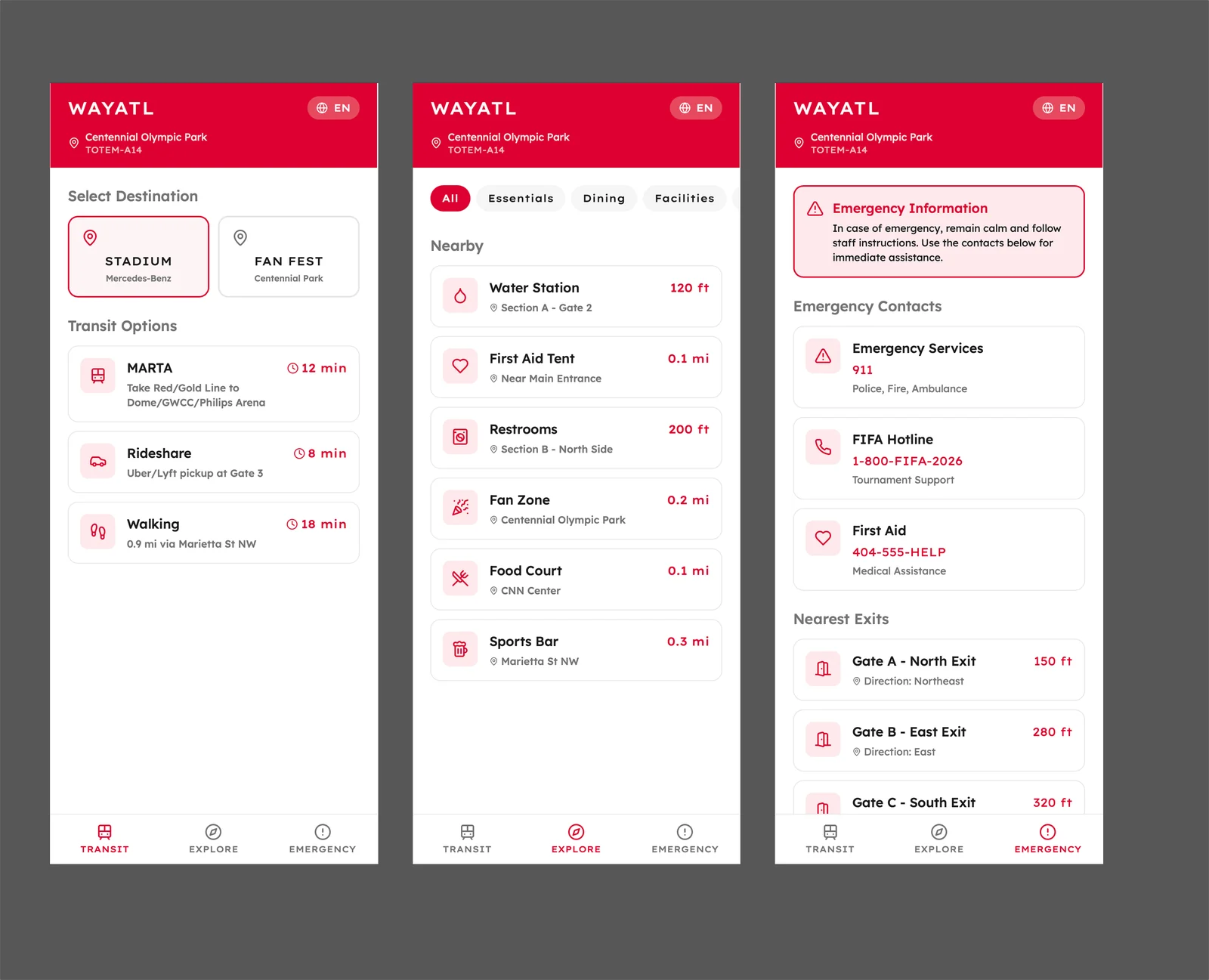
A high-fidelity Figma prototype covering three core functions of WayATL: Transit, Explore, and SOS.
06 — Testing
We tested WayATL over multiple rounds using two complementary methods. Heuristic evaluations with experienced UI/UX professionals surfaced usability issues early. Moderated guerrilla testing with fans unfamiliar with Atlanta showed how real visitors navigate under pressure and gave us task-level usability metrics.
Beyond the metrics, two themes came up again and again: WayATL needed to look like the World Cup, and its core actions needed to be impossible to miss.
We had built the UI on Metro Atlanta Chamber’s brand identity, since the Chamber sits on Atlanta’s FIFA Host Committee. Fans expected the product to look like the event itself.
“This product is for FIFA, but it doesn’t look like it.”UX professional
What we changedWe rebuilt the visual identity around FIFA’s World Cup 2026 branding.
The Transit, Explore and SOS buttons were too small and plain to signal that they were the app’s main actions.
“I can’t tell that these buttons are the most important.”FIFA fan
What we changedWe enlarged and highlighted the three core buttons so they take up most of the home screen.
07 — Solution
QR codes and NFC chips appear on towers, hotel tabletops, restaurant tables, and airport arrivals, reaching people at quieter moments, long before they are standing in a crowd.
WayATL is a mobile-first website built to Progressive Web App (PWA) standards: accessible on any smartphone, save-able to a home screen, with native location support. No app store. No friction for international visitors.
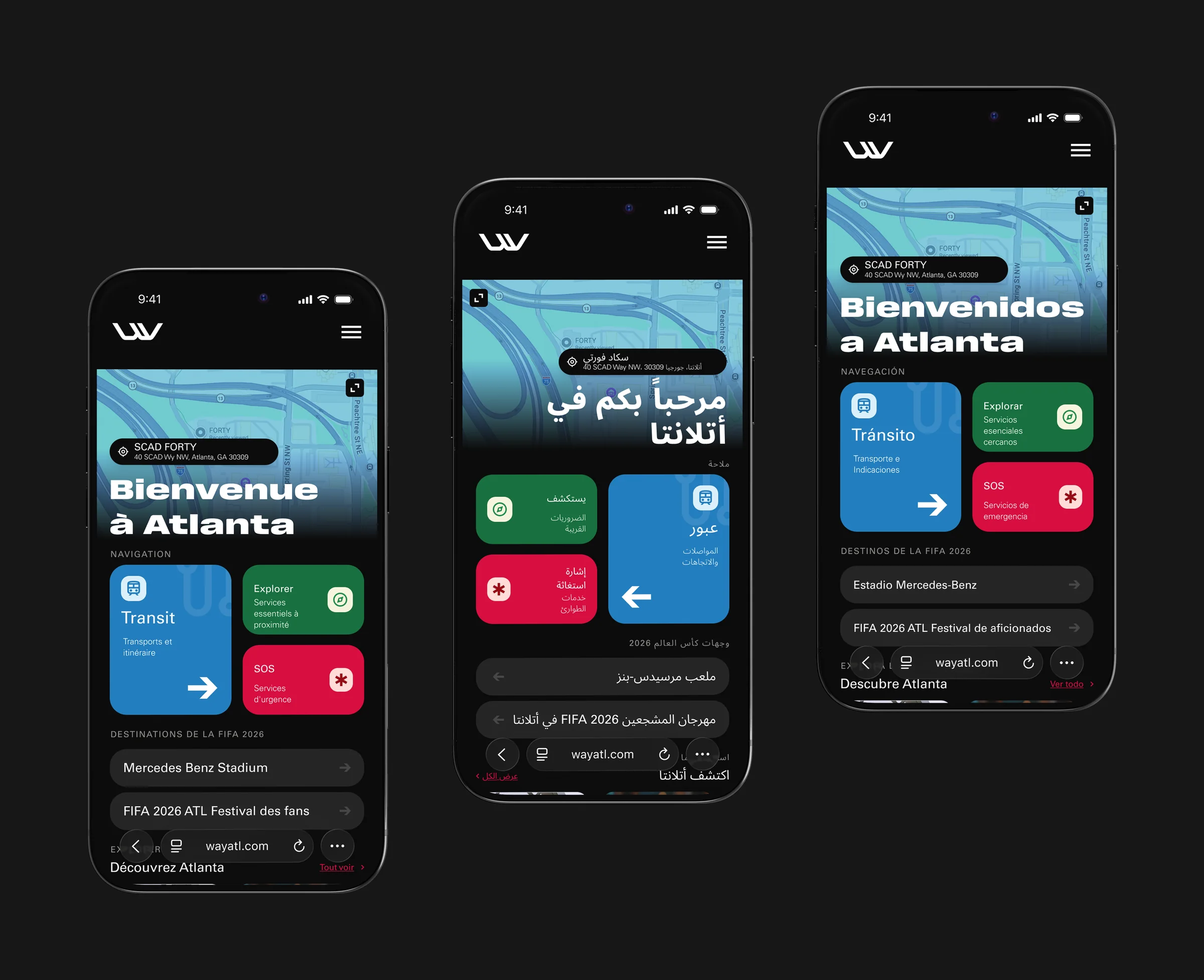
WayATL detects the user’s native phone settings from the first tap and customizes the language experience accordingly.
From the first scan to a call for help, here is each WayATL screen in motion.
The entry point, activated the moment a fan taps a tower or scans a QR code. No account required. The experience is live in under a second, in the fan’s native language.
Auto-detects the tower’s location and places the fan on the map, with no input required. Three primary actions surface immediately: Transit, Explore and SOS. FIFA 2026 destinations are preloaded and accessible without navigating or searching.
Every transport option, from walking and MARTA to micro-mobility and rideshare, is shown from the fan’s current position. Landmark-based directions give human-readable cues alongside the map. A step-free routing toggle prioritizes accessible pathways for visitors who need them.
Shows popular attractions nearby for fans to explore, and surfaces essentials such as food, restrooms, hydration points and first aid based on the fan’s exact location. Each result includes the walking distance and a direct link to navigate in the fan’s native map app.
911 and the FIFA 2026 emergency hotline are preloaded and one tap away. The nearest first aid location surfaces automatically based on the tower’s location. When FIFA command declares an emergency, a live evacuation map activates and its paths update in real time.
The same homepage, served in each fan’s phone language from the first tap, including a full right-to-left layout for Arabic.
08 — Reflection
Designing for a crowd taught me to design for a fan’s most stressful moment, not their average one.
Starting from the physical world shaped every decision. Because fans reach WayATL by scanning a tower, there is no download, no account and no language to choose, and the homepage already knows where they are standing. Testing kept us honest: every participant told us the first design didn’t feel like the World Cup, and moving to FIFA’s identity tied the product to the event fans came for.
With more time, I would test on-site during a live match day, where crowds, noise and weak signal are real rather than simulated, and validate the SOS flow and live evacuation map with the people who would run them.
Leading a two-person team over ten weeks, with AI-assisted tools speeding us from sketches to wireframes, showed me where my time matters most: less on polish, more on the questions only real users can answer.
